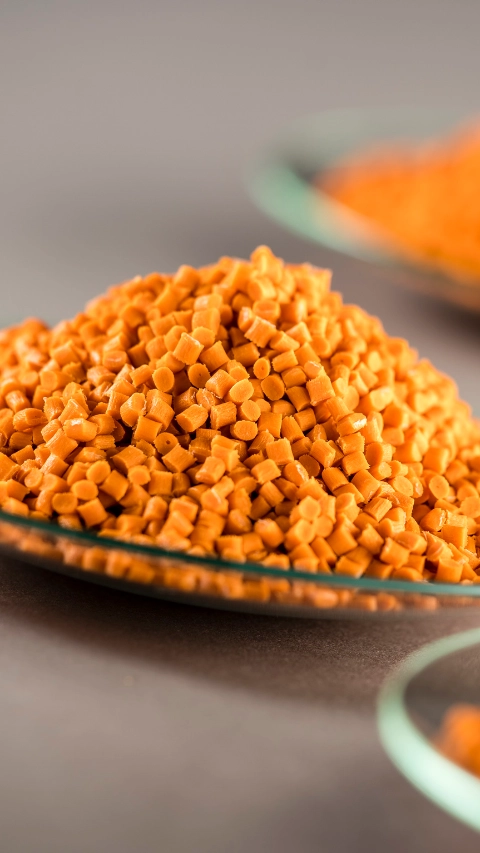
Orange granular material displayed in three glass scoops, with the front sample in sharp focus.
Performance Polymers

Performance Polymers

Ultradur® (PBT)

Ultradur® is BASF’s engineering plastic with partially crystalline, thermoplastic, saturated polyesters derived from polybutylene terephthalate (PBT). PBT Ultradur® is used for high-quality technical components in industries such as automotive, medical, and electrical.

Benefits

Key advantages of Ultradur®

  • High rigidity and strength
  • Very good dimensional stability under heat
  • Low water absorption
  • Good resistance to many chemicals
  • Exceptional resistance to weathering
  • Excellent heat aging behavior
Close-up of an electronic module housing showing internal circuit traces, connectors, and a black plug against a red background.

What are the properties of PBT Ultradur®? 

PBT Ultradur®’s mechanical, tribological, thermal, and electrical properties make it a strong, resistant, and durable engineering plastic.

Learn more about properties in our Ultradur® product brochure

How can PBT Ultradur® be processed?

PBT Ultradur® can be processed by all methods known for thermoplastics. The main methods are injection molding and extrusion.

Learn more about processing in our Ultradur®  product brochure

Which grades of PBT Ultradur® are available? 

Standard PBT grades

PBT Ultradur® is available in a comprehensive range of grades, including unreinforced, highviscosity, reinforced, impact-modified, and flame-retardant variants. For an insight into the whole portfolio, please consult our product range overview.

Ultradur® Product Range 

Ultradur® HPP - PBT with reduced cycle time and energy consumption

Benefits 

  •  Excellent flowability 
  • Faster crystallization
  • Significant reductions in cycle time
  • Significant reduction in process energy consumption
  •  High HDT (heat deflection temperature) values

Ultradur® HPP (High Productivity Plus) for significantly reduced cycle times and process energy consumption
Ultradur® HPP leads to significant reductions in cycle time and process energy consumption with potential reduction in cycle time of around 30%.

Why choose Ultradur® HPP?

Ultradur® HPP is an easy-flowing injection-molding grade with different glass fiber content for industrial parts with high dimensional stability requirements, for example for internal applications for vehicles, plug-in connectors and housings.

Measuring  the polymer’s resistance to distortion under a given load at an elevated temperature, Ultradur® HPP shows very high HDT (heat deflection temperature) values.

For manufacturers, a comprehensive moldflow data set is available, which helps to ensure optimal performance and efficiency throughout the production process.

Ultradur® HR - Hydrolysis-resistant PBT

Ultradur® HR features exceptional resistance to hydrolytic degradation caused by water and elevated temperatures. This is crucial for many electrical components and industries like automotive. 

Benefits 

  •  High resistance to water and heat damage
  • High hydrolysis resistance
  • Longer life in automotive electronics parts
  • Functionality in all climates

Contact with water in polyesters, even in the form of atmospheric humidity, leads to hydrolytic cleavage of the polymer chains and thus to a weakening of the material, particularly at elevated temperatures. Ultradur® HR is based on standard PBT, but incorporates highly effective additives which greatly retard the hydrolytic degradation and extend product life.

Discover the Ultradur® HR portfolio

Ultradur® LUX - Transparent PBT for laser welding 

Benefits

  • Laser transparency in the range of 900 to 1100 nm
  • Less scattering and less widening of the laser beam
  • Greater design freedom
  • Very wide process window
  • Shorter cycle times
  • High process consistency
  • High quality consistency
  • More flexibility
Cylindrical industrial component with metal housing and multiple electrical connectors, shown on a white background.

What is laser welding?

Laser transmission welding is a clean joining method which allows welding of parts with complex geometries in a quick, particle- and vibration-free way. This combination makes laser welding an especially interesting joining method with sensitive electronic parts. With Ultradur® LUX it is possible to use this welding method in the most efficient way.

Ultradur® B1520 FC -  PBT for food contact packaging

Ultradur® B1520 FC grades are specially developed high-flowability PBT for packaging applications. Combined with other grades, it can multiply performance while offering stiffness, strength, thermal stability and chemical resistance. These special properties make Ultradur® the product of choice for coffee capsules.

Benefits

  • Stiffness
  • Strength
  • Dimensional stability
  • Chemical resistance
  • Design freedom
  • Food contact safety
Small green seedling growing in a reused coffee capsule, surrounded by coffee beans and colorful capsules.

How can Ultradur® PBT be used in packaging?

Ultradur® B1520 FC R01's outstanding heat stability allows sterilization and hot filling. The shape of the packaging can be freely chosen due to its excellent barrier properties. There is no need for a 100% complete labeling to provide a barrier. Easy processing enables the usage on standard filling lines. Ultradur® B1520 FC R01 is certified for food contact, making it suitable for thin-walled packaging for cosmetics and food products.
 

Can coffee capsules be sustainable?

With our different sustainable approaches for products, you can make coffee capsules more sustainable by saving CO2!
Bar chart titled “Carbon Footprint of Ultradur® for coffee capsules” comparing fossil-based material with biomass-balance and ChemCycling® alternatives, showing lower carbon footprints for bio-methane, old tires, and mixed plastic waste feedstocks.

Ultradur® PRO - PBT for medical applications

Ultradur® PRO (Profile covered Raw materials Only) – PBT with highest formulation consistency has been optimized not only for medical applications (PRO = Profile covered Raw materials Only) but also with a comprehensive service package that guarantees formulation consistency and safety – from the raw material through to the patient.

Benefits

  • High dimensional stability
  • Ideal sliding and wear resistance
  • Broad chemical resistance to polar and non-polar solvents
  • High reproducibility and accuracy in molding parts
  • Low water/ moisture absorption
  • Excellent heat aging behavior
  • Good moldability with fast cycles
Two reusable injector pens, one white and one blue, shown side by side on a white background.

Why pair Ultradur® PRO with components made of Ultraform® PRO?

The pairing of components made of Ultraform® PRO and Ultradur® PRO offer extraordinary tribological synergy effects: Tribological modified Ultraform® PRO TR and Ultradur® PRO TR grades include a special lubricant which offers improved sliding properties in terms of exceptional low friction and low wear properties for complex mechanical devices: No squeaking or noise while being used.
✓ Suitable for dry run applications
✓ No external lubrication required - elimination of post siliconization process steps in production
✓ No running-in effects
✓ Smooth-running operation from the beginning
✓ Low breakaway forces

What is the application range of PBT Ultradur®? 

PBT Ultradur® is commonly used for connectors, electrical housings, gears and structural components in automotive, electrical and industrial applications. Manufacturers choose PBT Ultradur® because it combines low moisture absorption, dimensional stability and long-term heat resistance.

Red plastic electrical connector housing with a separate contact insert on a perforated metal surface.
Circuit protection
BASF offers a wide portfolio of materials for circuit protection products such as connectors, electrical components, and electrical components for photovoltaics
Electric vehicle with transparent body showing internal components, displayed beside a charging connector.
Automotive applications
BASF’s engineering plastics are suitable for exterior and interior automotive applications, electrics and electronics, eMobility, and powertrains.
Adult and child seated on a kitchen counter, interacting beside household appliances and potted herbs.
Appliances
PBT Ultradur® is the perfect choice for electrical household appliances, fulfilling requirements such as IEC 60335. 

Consult with an expert

Self-service solutions:       Downloads         Finders

1

FAQ ​

Q: What is PBT plastic?
Polybutylene terephthalate (PBT) is a high-performance engineering plastic used for demanding technical components. Ultradur® is BASF’s PBT which  combines high rigidity and strength with excellent dimensional stability, low water absorption and good chemical resistance.

Q: What applications is PBT Ultradur® suitable for?
PBT Ultradur® is used in a wide range of industries, including automotive engineering, electrical and electronic components, telecommunications, precision engineering and general mechanical engineering. Typical applications include connectors, housings, gears, structural parts and safety-relevant components that must perform reliably under varying environmental conditions.

Q: Which plastic material is suitable for automotive and eMobility applications?
Automotive and eMobility require materials with high mechanical strength. PBT Ultradur® combines these elements with excellent heat resistance, low moisture absorption and dimensional stability. Especially in high-voltage connectors, electronic housings and components exposed to heat and vibration, PBT Ultradur® is a reliable material ensuring safety and durability.

Q: Are there specialized PBT Ultradur® grades for demanding applications?
Yes. BASF offers a broad PBT Ultradur® portfolio that includes flame-retardant grades, hydrolysis-resistant grades for hot and humid environments, laser-transparent grades for laser welding, drinking-water-contact grades under the Aqua® portfolio, and medical grades under the PBT Ultradur® PRO portfolio. This allows manufacturers to select a material tailored to their specific performance and regulatory requirements.

Q: What material provides a good oxygen barrier for food packaging?
Materials with strong oxygen barrier performance are commonly used for products that require long shelf life and aroma protection. High-performance PBT solutions such as PBT  Ultradur® B1520 help minimize oxygen ingress and maintain product quality, making them suitable for applications such as coffee capsules, food containers, and specialty packaging.

Q: PBT vs. PP: Which material is better for food packaging?
The choice depends on the application. Polypropylene (PP) is widely used due to its cost efficiency, while PBT offers advantages such as higher stiffness, excellent dimensional stability, heat resistance, and improved barrier performance. For demanding applications like coffee capsules or thin-wall packaging, PBT can provide performance benefits that support product protection and packaging efficiency while increasing sustainability.

Q: Can packaging materials help reduce material consumption and improve sustainability?
Performance materials with high stiffness and strength, such as PBT Ultradur® B1520 enable thinner wall designs in packaging without sacrificing performance. This can reduce material usage, lower transportation weight, and improve resource efficiency. Combined with simulation-driven design optimization, manufacturers can further minimize material consumption and carbon emissions.

Q: What PBT material is suitable for laser transmission welding?
PBT Ultradur® LUX is a specialized PBT grade developed for laser transmission welding. Thanks to its exceptionally high and consistent laser transparency, it allows significantly more laser energy to pass through the transparent joining partner compared with conventional PBT materials. This results in wider processing windows, higher welding speeds, improved weld quality, and greater process reliability.