Performance Polymers
How can certified compostable and soil-biodegradable biopolymers contribute to a circular economy?


Certified compostable bioplastics as a means to increase organic recycling
Certified compostable (e.g. EN 13432) biopolymers do not substitute conventional plastics but complement them as special materials: They offer new properties and application possibilities - and are at the same time a means to increase organic recycling.They are, for example, the optimal solution for certified compostable
• organic waste bags, dual-use shopping bags
• cling film
• fruit and vegetable bags
• food packaging, e.g. coffee capsules, cups, lids, trays
• coatings of cups and wrappings made of paper or cardboard
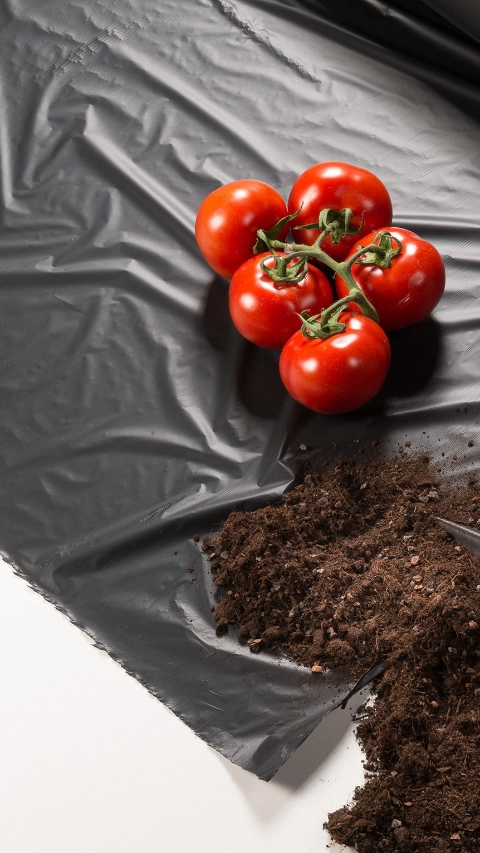
• or for soil-biodegradable mulch films in agriculture.
Correctly employed, certified compostable (EN 13432) and soil-biodegradable (EN 17033) biopolymers can contribute to reducing food waste, returning nutrients to the soil by generating greater volumes of compost and avoiding plastic contamination of agricultural soil caused by thin mulch films made of polyethylene.
Compostability: What are you interested in?
Browse here and explore how certified compostable biopolymers contribute to a responsible lifestyle.
Discover our biopolymers expertise
Biodegradability, compostability and certification
Biopolymers comprise a whole family of materials – from bio-based to biodegradable. When we speak of biodegradable plastics, it means that these plastics can biodegrade in a controlled environment – be it in industrial compost, in home compost or in agricultural soil. The end of life where this micro-organic activity takes place is organic recycling. Biodegradability claims must be accompanied by national or international standards that define the reference framework, the testing methods and the relevant environment. The proof of the complete biological degradability of a particular biopolymer grade is verified by independent certificates based on these approved standards.

More end-of-life options, more organic recycling: the effect of biopolymers
Certified compostable biopolymers extend the end-of-life options for plastic products. They support circular economy by helping to close the nutrient cycle of the food value chain - from production via responsible consumption to organic recycling and compost for farm soil. They do so by increasing shelf life of fresh food, enabling the easier collection of organic waste and preventing contamination from inappropriate plastic waste in organic recycling or in agricultural soil. Food losses from fruit and vegetables, which account for 30% of all greenhouse gas emissions of food waste, are reduced. As well, the addition of compost to the soil leads to a significant increase of soil organic carbon. Thus certified compostable biopolymers support the responsible handling of food along the value chain.Featured news


Experience how biopolymers prove their worth by enabling organic recycling
Looking ahead in bioplastics development?
Read the latest research news.
______________
Study by Wageningen University shows: compostable plastics break
down in less than 22 days in real-life industrial composting
A recent study by Wageningen University & Research (WUR), Netherlands, analyzed the fate of compostable packaging products in a full-scale industrial organic waste treatment facility. The independent research results confirm what producers of compostable plastics have been saying for a long time: The different tested EN13432 certified products broke down within a maximum of 22 days.
In a joint effort, the Dutch Waste Management Association and Holland Bioplastics, the association of the Dutch bioplastics industry, defined the research questions, which provided the basis for the project. While the waste management association selected and provided the composting plant, where the real-life test was conducted, the bioplastics producers provided the compostable packaging samples.

Independent study by ETH Zürich proves for the first time
the formation of biomass when PBAT biodegrades in soil
In contrast: Microorganisms use the carbon from a PBAT polymer both to generate energy and to form biomass. This means that PBAT biologically degrades in the soil and does not contaminate the soil as PE does.

We are a member of the European Bioplastics Association
European Bioplastics is uniquely placed in the industry with an extensive network of businesses, partners, and experts in the bioplastics sector across Europe and beyond.
Go to website

Technical articles on biopolymers by BASF and partners
Discover

Please read on


Which material is the right one for your application? We can help!

How BASF contributes to sustainability


Our biopolymers for a circular economy


Consult with an expert
Self-service solutions: