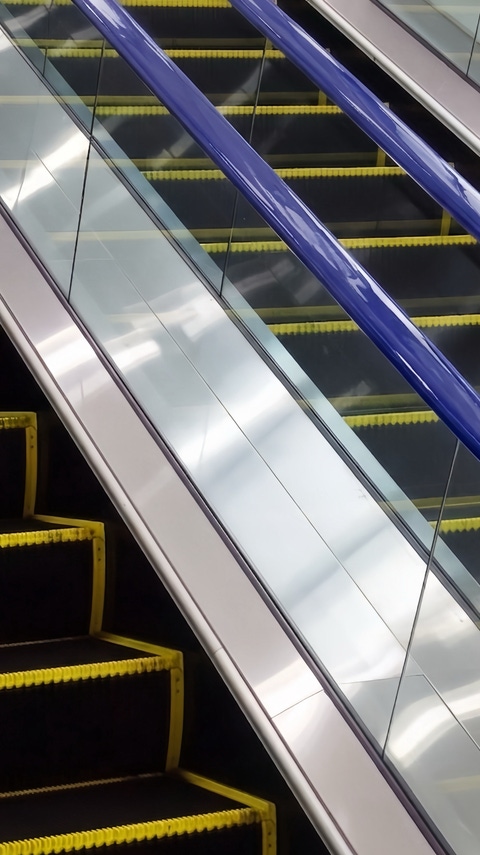
Escalator steps and handrails shown from above in a close-up view

Performance Polymers

Advancing  Escalator Handrails Performance with Elastollan® TPU

Key Benefits at a Glance

Elastollan® TPU for Handrails

  • Meets all critical performance requirements for escalator handrails
  • Enables design differentiation, fire compliance flexibility, and hygiene features
  • Supports efficient manufacturing and evolving sustainability needs

Material Requirements for Reliable Handrail Performance

Escalator handrails must consistently deliver reliable performance under continuous mechanical and environmental stress.

Elastollan® TPU is engineered to meet all essential handrail requirements, including:

  • Dimensional stability during operation
  • Flexibility and fatigue resistance under repeated bending
  • Abrasion and tear resistance in high-usage conditions
  • Resistance to chemicals, moisture, and environmental exposure
  • Thermal and processing stability for consistent manufacturing

These requirements represent the baseline for handrail materials in the industry. Elastollan® TPU fulfills these criteria, providing reliable performance across a wide range of operating conditions.

Why Choose Elastollan® TPU for Escalator Handrails?

While baseline requirements are essential, differentiation in modern handrail applications increasingly comes from additional functional capabilities.

What are the Manufacturing Advantages of Elastollan® TPU? 

Elastollan® TPU supports efficient extrusion processing, enabling:

  • Simplified production process and enhanced productivity compared to conventional rubber production lines
  • Reduced labor intensity during manufacturing
  • Consistent product quality through controlled processing conditions. 

These characteristics contribute to improved operational efficiency and cost‑in‑use for handrail producers.

Handrail Construction with Elastollan® TPU

Elastollan® TPU allows for integration into established handrail constructions without requiring significant changes to cross‑sectional design.

Compared to constructions that rely on multiple bonded layers, Elastollan® TPU supports more cohesive material systems, which helps to improve structural consistency and reduce risks associated with long‑term material separation.

This enables straightforward material implementation while maintaining compatibility with existing handrail designs.

Two black plastic edge trim profiles, one shown assembled and one with its inner layer exposed.

BASF Expertise in Elastollan® TPU Solutions

Our Service Package

Discover our full range of comprehensive services with leading technologies and products—find the one that fits your needs!

FAQ

Q: What is the best material for escalator handrails?

There is no single “best” material for escalator handrails, as performance depends on system design and operating conditions.
Traditionally, rubber has been widely used. Thermoplastic polyurethane (TPU), such as Elastollan®, is also now widely used and meets these core performance requirements.
 

Q: Which polymer is most durable for escalator handrails?

Durability depends on a combination of properties such as abrasion resistance, fatigue performance, and resistance to environmental exposure.
Thermoplastic polyurethane (TPU) offers a balanced property profile, including resistance to wear and repeated bending, making it suitable for high-usage conditions.
 

Q: What are alternatives to rubber handrails?
In addition to traditional rubber-based constructions, thermoplastic polyurethane (TPU), such as Elastollan®, is widely used as an alternative material for escalator handrails.
As a thermoplastic material, TPU enables different processing compared to crosslinked rubber and supports recyclability of production scrap, depending on system conditions.