Key Benefits of E-TPU in Footwear
- High rebound and resilience
- Excellent mechanical properties
- Long-term durability
- Wide temperature range (down to -20°C)
- Low density (140–240 g/L)
Performance Polymers
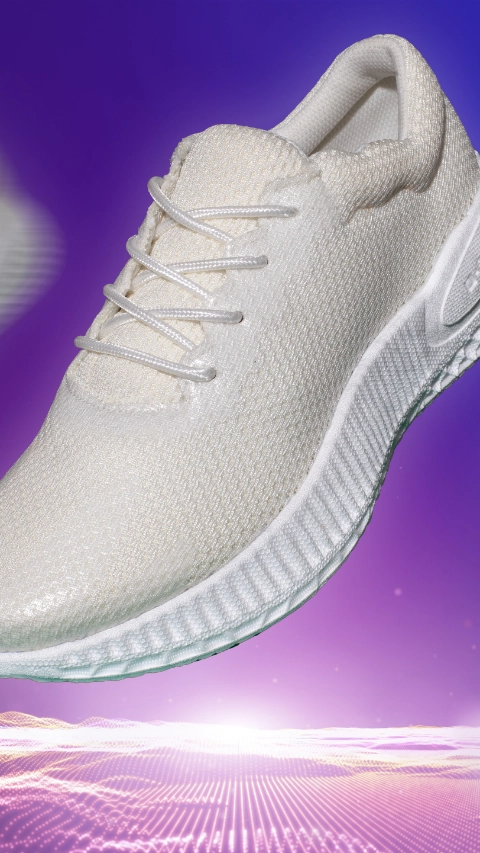
Infinergy® Revolution (E-TPU) provides access to a variety of molding processes while keeping the Infinergy® identity of making shoes very comfortable to wear and delivering excellent running properties. Due to new processing methods the expanded thermoplastic polyurethane (E-TPU) material can be fused into soles in a much more energy-efficient and material-friendly manner. With endless design possibilities many surface textures are available. Its durability and recyclability allow Infinergy® Revolution (E-TPU) to strive for a more sustainable future of the footwear industry.
Cooling and water content influences the surface appearance and effective part density.
Cooling rate
Mold preparation
Heat press curing
Filling & compaction
Material conditioning
Simple process
Applying pressure around 3 bar for 5 hours
Did you know?
Known from EPP production process, a pressure loading of Infinergy® beads is likewise possible to reduce the final part density significantly.
Pressure loading enables post expansion of Infinergy®
Effect of using pressurized beads
Part density vs. Mechanical properties
Physical effect
Compressed air diffuses into Infinergy® bead. After releasing the system pressure at theend of the process, the pressure remains inside the beads for some time leading to twoeffects:
The bulk density can slightly reduce
The internal pressure stabilizes the bead for the welding process in the heat press.
This internal stabilization enables an effective reduction of the component density.
Trends in footwear manufacturing
Automation: reduced manpower, „one shot“ production of bottom unit or full shoe
Customization: iconic look, brand DNA integrated in design
Sustainability: PCF reduction, recyclability, waste reduction
Self-service solutions:
Q: What is the Heat Press Process for Infinergy® Revolution (E-TPU) and what is it used for?
The Heat Press Process is the core manufacturing method for Infinergy® Revolution (E-TPU) components, especially shoe soles. In this process, expanded TPU beads are fused together under heat and pressure to produce lightweight, elastic, and performance components with high energy return.
Q: How does the Heat Press Process work for Infinergy® Revolution (E-TPU)?
The Heat Press Process for Infinergy® Revolution (E-TPU) consists of five steps: material conditioning, mold preparation, filling and compression, heating to approximately 130–145 °C, and cooling and demolding. Uniform heat transfer is critical to ensure that the particles fuse completely and stably.
Q: Why is the Heat Press Process important for the performance of shoe soles?
The Heat Press Process determines the mechanical properties of Infinergy® components. Optimized processing ensures high cushioning, strong energy return, and long-lasting performance. These are key factors for applications such as midsoles in performance footwear.
Q: What factors influence quality in the Heat Press Process?
The main influencing factors are temperature (approx. 130–145 °C), pressure distribution, process time, and cooling conditions. These parameters define density, surface quality, and the mechanical stability of the component.
Q: What is Pressure Loading in Infinergy® Revolution (E-TPU) and what advantages does it offer?
Pressure Loading is an advanced processing method for Infinergy® Revolution (E-TPU) in which the material is deliberately compressed under pressure to create controlled expansion after pressure release. This results in lighter components with lower density while maintaining high performance.
Q: How does Pressure Loading work in E‑TPU?
During Pressure Loading, the cell structures of the Infinergy® Revolution (E-TPU) beads are first compressed. After the pressure is released, the cells expand again, increasing the component’s volume and reducing its density.
Q: Why is Pressure Loading crucial for lightweight shoe soles?
Pressure Loading enables a significant reduction in the weight of shoe soles without compromising mechanical stability or energy return. This leads to improved comfort and better running performance.
Q: How does Pressure Loading affect material properties?
Pressure Loading improves the weight efficiency of Infinergy® Revolution (E-TPU), enhances cushioning properties, and maintains structural stability. This results in an optimal balance of weight, comfort, and performance.
Q: What is the difference between Infinergy® Revolution (E-TPU) with and without Pressure Loading?
Without Pressure Loading, the material has a higher density and a more compact structure. With Pressure Loading, a more expanded cell structure is created with lower density, resulting in lighter yet performance components.


