Performance Polymers
Beyond the Chip: Solving the Physical Constraints of Hyperscale Data Centers
The unprecedented acceleration of AI development is best seen in the surge of data center investment globally. In 2025, U.S. construction spending on AI infrastructure hit $443 billion, a 73% increase over 2024. Forecasts for 2026 suggest capital expenditure (CapEx) will climb even further, reaching between $600 and $700 billion1. Add to that another €200 billion from the EU to triple the amount of data centers in its “AI continent action plan”2. And also China, that treats AI not just as a tech sector, but as the central industrial policy backbone of its entire economy in its 15th Five-Year Plan3.
These record-breaking investments represent more than just digital growth; they are the direct funding of Physical AI: the hardware and the connectivity required to give AI a body in the real world. As AI is not just software and is constrained by the laws of physics, our role at BASF Performance Materials is to remove these physical bottlenecks - thermal, structural, and environmental - that could stand in the way of this transition.
[1] Hyperscalers Plan $630 Billion in 2026 CapEx
[2] AI continent - European Commission
[3] China's Blueprint: What the 15th Five-Year Plan Means for Global Investors | Neuberger
The material science behind the AI infrastructure journey starts here
The world is currently home to approximately 12,000 operational data centers, of which nearly 1,000 are hyperscale facilities. Hyperscale facilities differentiate by the density of racks of servers: from a few thousand to hundreds of thousands, all interconnected in large cable spaghettis.
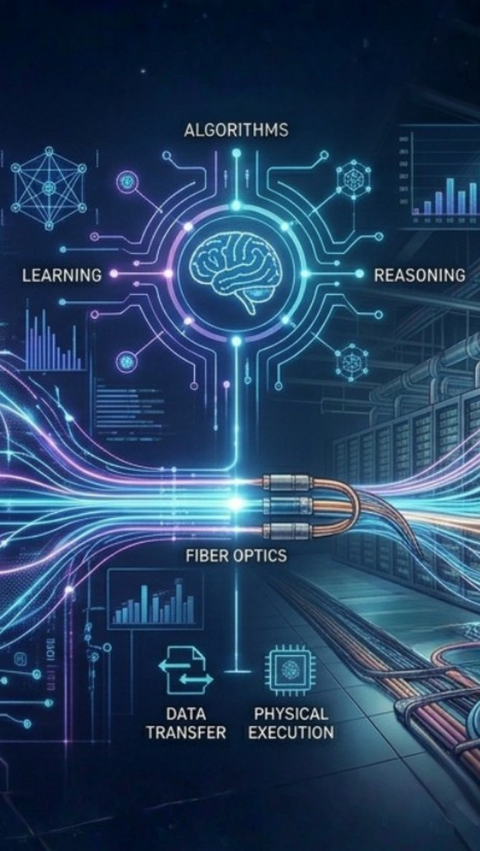
The transition from copper cables to fiber-optic cable assemblies came with numerous advantages in bandwidth and scalability. Here, high-performance plastics play an essential role, providing flexibility, flame retardancy, and thermal stability required at scale.
But extreme density introduces significant physical constraints. Blocked airflow can create "hot spots" that trigger thermal throttling, a safety mechanism that slows down AI processing to prevent damage. Managing these thermal issues is not just a performance requirement; it is also a fire safety imperative.
For every problem its solution. BASF Performance Materials has the right product portfolio and application know-how to make data centers and hyperscale facilities run efficiently: from cables jacketing to connectors, to insulation materials.
How do high-performance plastics improve data center cooling efficiency?

Think of a data center as a giant heat engine: servers and chips generate massive thermal loads that must be handled by the HVAC systems. To operate efficiently, this thermal energy needs to be carefully controlled. High‑performance insulation across pipes, ductwork, and the building envelope (walls, roofs, and floors) plays a critical role in minimizing heat losses and preventing unwanted thermal transfer.
Effective insulation enables precise temperature management, reduces the energy required for cooling, and helps maintain stable operating conditions. By optimizing thermal performance, it contributes directly to lower energy consumption and operating costs. Our specialized polyurethane portfolio provides industry‑leading insulation solutions designed to meet these demanding requirements and support the efficient, reliable operation of modern data centers.
Why is thermal stability critical for hyperscale AI performance and fire safety?
Thermal stability is a critical enabler of reliable data processing performance. As computing workloads intensify, processors such as Central Processing Units (CPUs) and Graphics Processing Units (GPUs) generate significant amounts of heat by dealing with large amount of data.
If temperatures exceed defined thresholds, systems automatically reduce their operating frequency in a process known as thermal throttling, leading to immediate performance degradation and reduced throughput.
But we are not only managing heat for performance; we are also managing it for safety. High-performance plastics play a silent but critical role to maintain structural integrity and electrical insulation at continuous operating temperatures.
In a hyperscale environment packed with kilometers of cable, the use of high-performance and flame-retardant materials is non-negotiable. These specialized plastics safeguard performance and safety.

How does the shift from copper to fiber-optic cabling impact AI data throughput?
The primary bottleneck for AI is no longer just processing power; it’s data throughput. This is driving a massive transition from traditional copper cables to fiber-optic cable assemblies. While copper is struggling with distance and heat generation at high speeds, fiber optics offer the bandwidth required for the next generation of GPUs.
However, fiber is delicate. This is where high-performance plastics step in:
Precision Connectors: Fiber optics require sub-micron alignment. Plastics like specialized polyamides or PBT (Polybutylene Terephthalate) provide the dimensional stability needed to ensure connectors don't warp under heat, which would otherwise lead to signal loss.
Cable Jacketing: As cables become thinner and more densely packed, the "skin" of the cable must be tougher. High-performance sheathing protects fragile glass fibers from mechanical stress and micro-bending during installation in cramped server racks.


Can plastics contribute to a sustainable expansion of AI?
As AI demand accelerates, so does the need for materials that support efficiency. But sustainability must exist across the entire lifecycle. This is what we call #OurPlasticsJourney at BASF.
In plastic production, the make phase, continuous innovation is improving how plastics are produced, with an increasing shift toward alternative raw materials with lower carbon footprints, including renewable and recycled feedstocks.
Which high-performance materials are essential for reliable AI infrastructure?
BASF Performance Materials has a portfolio specifically engineered to meet the data centers requirements in thermal stability and management, flexibility, durability and sustainability. Here are some of our key products:


Consult with an expert
Self-service solutions: